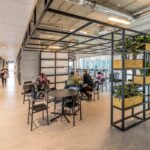
When we talk about employee wellbeing, the conversation usually gravitates toward wellness programs, flexible working policies, or mental health initiatives. All of those things matter, but there is one factor that often gets overlooked: the physical environment where people spend the majority of their working week. I have spent a lot of time thinking about this, and the more I look at what research tells us alongside what I observe in real Sydney workplaces, the clearer it becomes that office design is not a cosmetic consideration. It is a foundational one. Choosing professional workplace refurbishment Sydney services is one of the most direct investments a business can make in the people who show up every day to do their best work. This article explores exactly how workplace design shapes wellbeing, and what Sydney businesses can do about it.
1. The Connection Between Space and State of Mind
There is a well-established body of research linking physical environments to psychological states. Crowded, cluttered, or poorly lit spaces elevate cortisol levels and trigger low-grade stress responses that accumulate over a working week. Conversely, spaces that feel considered, ordered, and comfortable tend to support focus, calm, and a sense of professional pride. I find it telling that many employees who describe their workplace negatively use spatial language: it feels cramped, it is too loud, there is nowhere to think. These are not complaints about management or strategy. They are complaints about design. For Sydney businesses operating in competitive talent markets, this matters enormously. When candidates walk into your office, they are forming an impression not just of your culture but of how much you value the people who work there. A dated, cluttered, or dysfunctional space communicates something unintended, and often, something costly.
2. Natural Light and Its Direct Impact on Productivity
Ask any occupational psychologist what single design feature has the most measurable impact on employee wellbeing, and the answer is almost always natural light. Access to daylight regulates circadian rhythms, supports vitamin D production, reduces eye strain, and has been directly linked to better sleep quality in workers who have consistent access to windows. In Sydney, where the climate and light quality are genuinely exceptional, failing to harness natural light in your office design feels like a particular waste. The challenge for many Sydney businesses, particularly those in CBD high-rises or warehouse conversions with limited window frontage, is distributing light effectively through their floor plate. This is where thoughtful design decisions, such as using glass partitions instead of solid walls, choosing light-reflective surfaces, and positioning workstations intelligently, can make a significant difference. Stemar Group works with Sydney businesses to assess how light moves through a space and how partition and fitout choices can maximise its reach.
3. Acoustic Comfort: The Overlooked Wellbeing Issue
Noise stress is one of the most frequently cited sources of workplace dissatisfaction, and yet it remains one of the least addressed. The open-plan office trend, which swept through Sydney’s corporate and startup worlds over the past fifteen years, created spaces that are visually collaborative but acoustically punishing. When people cannot concentrate without wearing headphones, when phone calls feel like public performances, and when a nearby conversation derails an entire thought process, wellbeing suffers in very concrete ways. Prolonged exposure to uncontrolled ambient noise has been linked to increased anxiety, reduced cognitive performance, and even elevated blood pressure over time. The solution is not to abandon open-plan design entirely but to layer it with thoughtful acoustic management. Stemar Group’s office refurbishment work in Sydney consistently incorporates acoustic partition systems, sound-absorbing panels, and material choices that reduce reverberation without making a space feel sterile or closed off. Getting acoustics right is genuinely one of the most impactful wellbeing investments a workplace can make.
4. Biophilic Design: Bringing the Outdoors In
Biophilic design is the practice of connecting built environments to the natural world, and its effects on human wellbeing are not trivial. Studies have shown that the presence of plants, natural materials, views of greenery, and water features in workplace settings reduces stress, lowers heart rate, and improves mood and attention. For Sydneysiders, who often have a strong cultural connection to outdoor living, a workspace that feels completely disconnected from the natural world can create a subtle but persistent sense of dissonance. You do not need to install a living wall or a rooftop garden (although both are wonderful if budget permits). Even modest biophilic touches, such as timber accents, potted plants, natural stone finishes, or a dedicated breakout area that opens onto a balcony, can shift the atmosphere of an office noticeably. When Stemar Group consults on office refurbishment projects in Sydney, biophilic elements are increasingly part of the conversation, particularly with clients who want their workspace to reflect the city’s natural character.
5. Ergonomics as a Foundation, Not an Afterthought
Physical wellbeing and psychological wellbeing are deeply connected, and nowhere is this more apparent than in ergonomics. Poor ergonomic design is a slow accumulator of harm. It rarely causes dramatic, immediate problems, but over months and years it contributes to chronic back pain, repetitive strain injuries, neck tension, and fatigue that erodes energy and mood. In Sydney, where many knowledge workers spend seven to nine hours a day at a desk, the quality of that desk setup is a significant health variable. Height-adjustable desks, well-positioned monitors, supportive seating, and adequate legroom are not luxury features. They are basic infrastructure for sustainable working. Any serious office refurbishment should include an ergonomic audit of workstations as a standard part of the brief. Stemar Group approaches Sydney office refurbishment with this lens, ensuring that the furniture and spatial choices made during a fitout genuinely support the bodies of the people using them, not just the aesthetic brief.
6. The Role of Breakout and Social Spaces
Wellbeing at work is not purely about focused productivity. It is also about human connection, rest, and the informal interactions that build a team’s sense of identity and trust. Breakout spaces, kitchen areas, informal lounge zones, and outdoor terraces all play a role in supporting the social dimension of work. I have noticed that organisations that invest in genuinely comfortable and inviting social spaces tend to have stronger cultures, not because the space causes the culture, but because it creates the conditions for culture to form naturally. In Sydney’s increasingly hybrid work environment, the social pull of the office is more important than ever. If people are choosing to come in rather than work from home, the office needs to offer something worth coming for. A well-designed breakout area, a good coffee setup, and a lounge space where people can have a casual conversation without feeling like they are interrupting the whole floor are small investments that pay off in intangible but real ways. Stemar Group includes social and breakout space planning in their Sydney office refurbishment services, recognising that these zones are not optional extras but central to how modern workplaces function.
7. Privacy and the Right to Focus
Open-plan offices promised collaboration, but they often delivered an inability to have a private conversation or a sustained period of concentration. The wellbeing consequences of this are significant. Employees who lack access to private or semi-private spaces report higher levels of stress, lower job satisfaction, and a greater tendency to disengage. This is particularly acute in roles that involve confidential client conversations, complex analytical work, or simply people who are introverted and need periods of quiet to perform at their best. Creating privacy within an open-plan office does not require building a series of closed rooms. Well-placed partitions, acoustic booths, phone pods, and defined quiet zones can give people the sense of control over their environment that underpins genuine workplace wellbeing. Stemar Group’s expertise in office partition systems across Sydney makes them a practical resource for businesses that want to retrofit or refurbish a space with privacy-enabling solutions that still feel open and light-filled.
8. Temperature, Air Quality, and the Basics That Still Get Ignored
It might seem basic, but thermal comfort and air quality remain among the most commonly cited sources of workplace dissatisfaction in office environments. Being too cold, too warm, or working in a space with poor ventilation and stale air creates a background discomfort that quietly drains energy and concentration throughout the day. In Sydney, where summer temperatures can be extreme and air conditioning systems are often set to accommodate the most vocal complainant rather than the majority of users, thermal comfort is a genuine daily challenge. When planning an office refurbishment, it is worth conducting a proper HVAC assessment to ensure airflow and temperature zoning are appropriate for your floor plan and headcount. Fresh air circulation, in particular, has been linked to measurable improvements in cognitive function. These are not glamorous design considerations, but they are ones that Stemar Group and their network of Sydney trade partners factor into refurbishment projects because the basics matter as much as the aesthetics.
9. Design That Reflects and Reinforces Culture
Workplace wellbeing is not just physical. It is also about belonging, identity, and pride in the place where you work. When an office reflects the values and personality of the organisation, people feel seen and understood. When it feels generic, dated, or indifferent, it communicates, however unintentionally, that the organisation is not paying attention. I have spoken to employees who describe a well-designed office as a reason they stay in a role, not because of the space itself but because of what it signals about how the company thinks about its people. Branding a workspace does not mean plastering logos everywhere. It means making deliberate choices about colour, materials, art, and atmosphere that connect to what the organisation stands for. When working with Stemar Group on a Sydney office refurbishment, bringing your brand identity into the design brief ensures the resulting space feels genuinely yours rather than a generic template.
10. The Cost of Getting It Wrong
There is a tendency to view office design investment through the lens of cost rather than return. But the cost of not investing is often greater and less visible. High turnover driven partly by an uninspiring or uncomfortable workspace, reduced productivity from noise and poor ergonomics, increased sick leave linked to stress or physical discomfort, and difficulty attracting talented candidates all carry real financial weight. In Sydney’s competitive employment market, where skilled workers have genuine choices about where they work, the quality of the physical workplace is a measurable competitive variable. A professional office refurbishment is not a vanity project. It is a strategic investment in retention, performance, and the kind of culture that sustains a business through difficult periods. Stemar Group works with Sydney businesses of all sizes to deliver refurbishments that are practical, budget-conscious, and genuinely transformative in how they support the people who use them every day.
Final Thoughts
Workplace design and employee wellbeing are not separate conversations. They are deeply intertwined, and the physical environment your team occupies every day either supports or undermines the broader wellbeing investments your organisation makes. The good news for Sydney businesses is that a thoughtful, well-executed office refurbishment does not have to be a monumental undertaking. Even targeted improvements to lighting, acoustics, ergonomics, and social spaces can produce meaningful shifts in how people feel about coming to work. If you are thinking about where to start, Stemar Group’s office refurbishment services in Sydney offer a practical and experienced partner for that process. They understand that the goal is not just a prettier office, but a space that genuinely serves the people in it.