
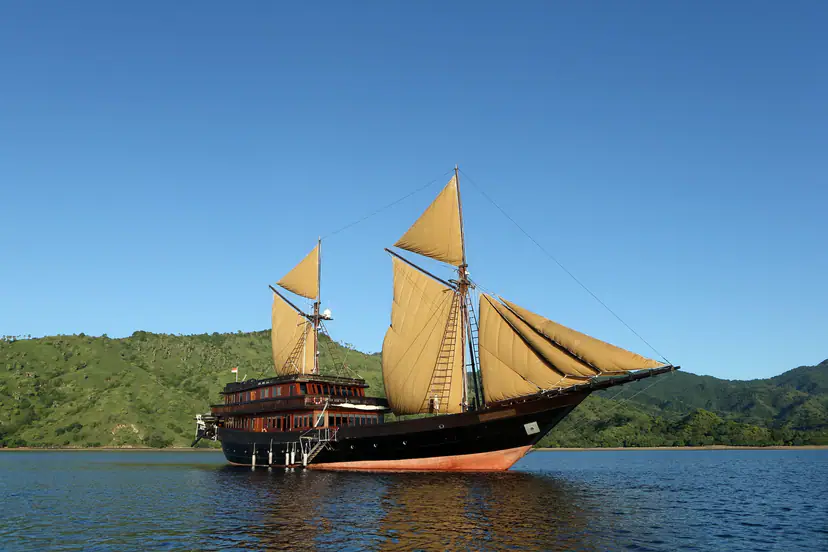
For divers planning an expedition in Indonesia, choosing the right vessel can shape the entire experience above and below the water. A modern dive boat may offer efficiency, advanced engineering, and a highly structured onboard setup. But for travelers who see the journey as part of the adventure, a traditional phinisi offers something different.
Alila Purnama exemplifies how the Indonesian sailing tradition can be combined with a contemporary liveaboard experience. Instead of simply moving divers from one site to another, a phinisi can make the time spent crossing the archipelago feel like part of the destination itself.
So why do some divers choose a traditional Indonesian phinisi instead of a modern dive vessel?
The answer often comes down to atmosphere, connection to place, and the type of journey they want to have.
What Makes a Phinisi Different From a Modern Dive Vessel?
A modern dive vessel is generally designed around efficiency. The layout may prioritize dive decks, equipment storage, quick access to tenders, and streamlined operations between dive sites. This can be ideal for divers whose main priority is maximizing time underwater.
A phinisi, however, brings another dimension to the experience.
The Indonesian Pinisi, an art of boatbuilding in South Sulawesi, was inscribed on UNESCO’s Representative List of the Intangible Cultural Heritage of Humanity in 2017. The tradition represents generations of maritime knowledge, boatbuilding skills, and navigation connected to Indonesia’s seafaring communities.
For travelers, this means the vessel itself can become part of the story.
There is a difference between arriving at a remote island on a purely functional dive platform and arriving there after spending the morning on the deck of a wooden sailing vessel, surrounded by Indonesia’s islands.
For some divers, that difference matters.
The Journey Becomes Part of the Dive Trip
Indonesia is not a destination that can always be understood from a single dive site or resort.
The country’s geography makes movement through the archipelago an important part of the experience. Indonesia’s official 2025 national map describes the country as an archipelago of 17,380 islands.
A liveaboard allows travelers to experience that geography directly.
Between dives, the landscape changes. Volcanic islands may give way to small beaches, limestone formations, isolated anchorages, or long stretches of open water. This is particularly relevant for destinations where the distance between experiences is part of the appeal, including a Komodo yacht charter or an expedition focused on sailing through more remote regions of Indonesia.
A traditional vessel can make those transitions feel less like transportation and more like travel.
Why Do Some Divers Prefer the Atmosphere of a Wooden Vessel?
Diving trips are often remembered for more than marine life.
Divers may remember the manta ray encounter or the perfect visibility on a reef, but they also remember sunrise before the first dive, conversations on deck, the sound of the sea at anchor, and the islands visible from the boat.
A phinisi creates a particular atmosphere because its identity is closely connected to Indonesia itself.
The Pinisi tradition has long been associated with South Sulawesi’s maritime culture, and UNESCO notes that boatbuilding and sailing remain closely tied to the identity and livelihoods of communities in major boatbuilding centers such as Tana Beru, Bira, and Batu Licin.
That cultural connection can appeal to travelers who want their accommodation and transport to feel specific to the country they are visiting rather than interchangeable with a similar vessel anywhere else in the world.
This is one reason Alila Purnama can appeal to divers seeking more than a standard liveaboard schedule.
Diving Is Still the Priority
Choosing a phinisi does not necessarily mean sacrificing the practical side of a dive expedition.
For serious divers, the quality of the itinerary, crew, dive operation, guides, equipment handling, and access to marine environments remains essential. The ideal vessel combines the operational requirements of diving with a memorable onboard experience.
That matters in Indonesia because the country sits at the heart of the Coral Triangle, one of the world’s most important centers of marine biodiversity.
The Coral Triangle spans just 1.6% of the planet’s oceans but contains approximately 76% of known coral species and 37% of known coral reef fish species.
In Raja Ampat, the biodiversity is particularly remarkable. The Coral Triangle Atlas identifies the Bird’s Head region of Indonesian Papua as the center of the region’s coral diversity, with Raja Ampat containing 553 coral species.
For divers planning a Raja Ampat boat charter, access to these environments is clearly important. But the experience doesn’t have to end when the dive is over.
A vessel can provide both a platform for exploring the underwater world and a comfortable space to experience the surrounding landscape.
Modern Efficiency or a More Immersive Journey?
Neither type of vessel is automatically better.
A modern dive boat may be the right choice for travelers who want a highly technical, efficient, and dive-focused experience. A phinisi may be more appealing to travelers who want diving to be one part of a broader journey through Indonesia.
The decision often depends on one simple question:
Do you see the boat as transportation, or as part of the destination?
For divers primarily interested in completing a demanding dive schedule, operational efficiency may be the deciding factor.
For others, the experience of being on the water matters just as much.
They may want time to enjoy the scenery between dives, visit islands, watch the coastline change, or simply spend a quiet afternoon on deck. This approach can also appeal to couples, families, and mixed groups where not every guest has exactly the same diving priorities.
A Different Way to Experience Indonesia
The growing appeal of experiential travel has changed what many travelers expect from a diving holiday.
Rather than separating diving, accommodation, transportation, and destination experiences, a well-designed liveaboard can bring them together.
Alila Purnama represents this type of journey by combining the character of an Indonesian phinisi with the practical requirements of exploring the country’s islands and marine environments.
For travelers considering a yacht charter in Indonesia, the choice may therefore be less about whether a traditional vessel is better than a modern one.
It is about deciding what kind of memories they want to create between dives.
Is a Phinisi the Right Choice for You?
A traditional Indonesian phinisi may be the right option if you value:
- A stronger connection to Indonesian maritime culture
- A more atmospheric experience between dives
- Island scenery and the journey itself
- A combination of diving and broader exploration
- A vessel with a distinctive sense of place
A modern dive vessel may be better suited to travelers whose priority is purely operational efficiency and a highly dive-focused schedule.
Ultimately, some divers choose a phinisi because they do not want to simply visit Indonesia’s dive sites. They want to travel through Indonesia.
And in a country defined by thousands of islands, extraordinary marine biodiversity, and centuries of maritime tradition, the vessel you choose can become an important part of the expedition.
For those seeking an experience where time above the water is as memorable as time below it, Alila Purnama offers a compelling way to explore the Indonesian archipelago.


